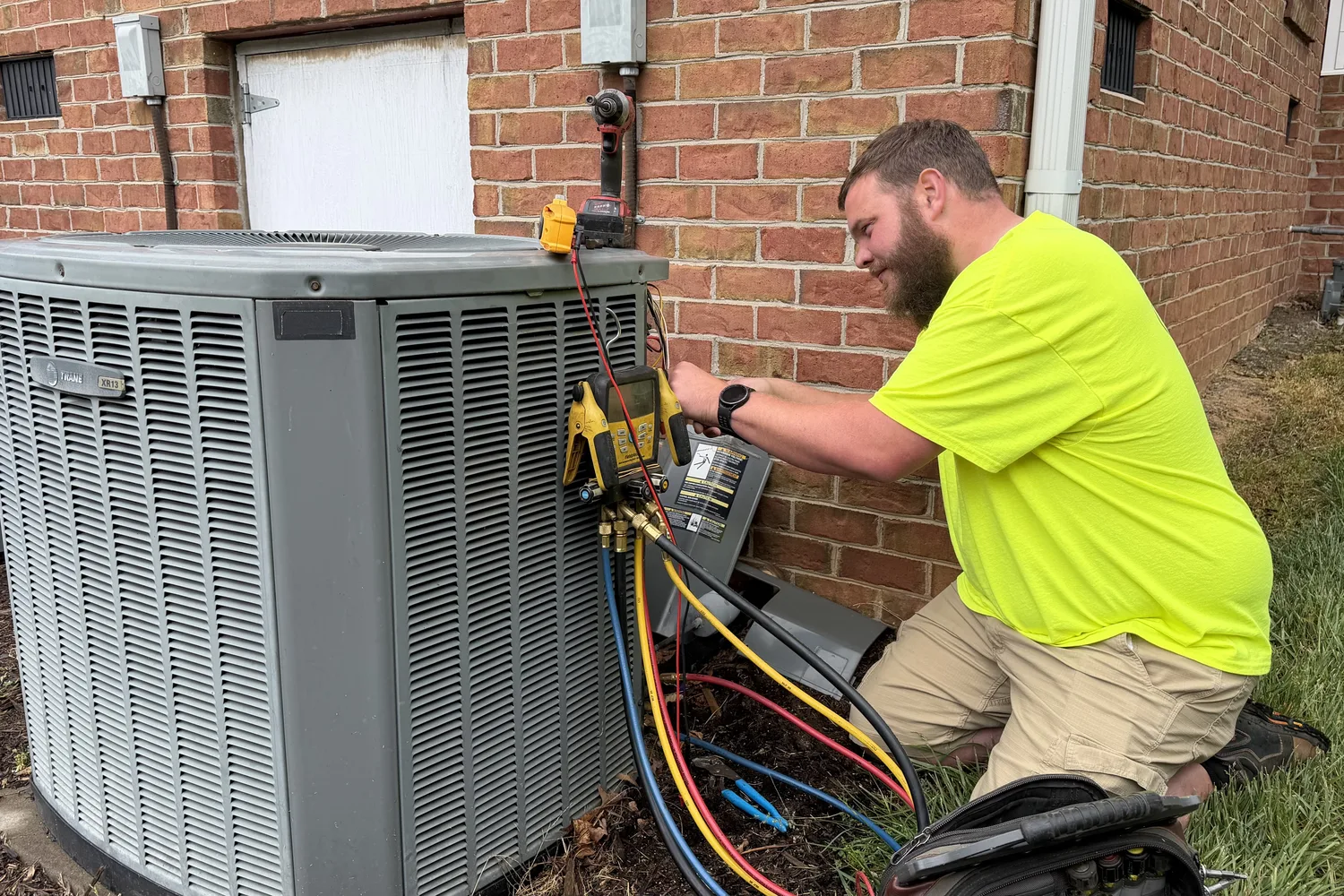
When your heat is running but the vents blow cool air, the cause is often simple: a thermostat fan setting, a clogged filter, or, on a heat pump, normal operation that just feels cool to the hand. Real breakdowns happen too, like a dirty flame sensor on a furnace or a stuck reversing valve on a heat pump, and those need a technician. This guide starts with the question that sorts it out (furnace or heat pump?), then walks through the checks you can safely do yourself, the common causes for each system, and the signs that mean you should shut the system off and call. If the checks don’t bring the heat back, Dyer’s is on call 24/7 at (336) 863-1963.
Start here: do you have a furnace or a heat pump?
The same symptom means different things on each system, so this comes first. A gas furnace burns fuel, and the air coming off its heat exchanger is around 150°F, according to building scientist Allison Bailes of Energy Vanguard. A heat pump moves heat in from outdoors instead of making it, and its supply air usually runs between 90 and 110°F. Air in the 90s is cooler than your skin, so a heat pump register can feel cool to your hand while the system heats the house normally. On a furnace, air that feels truly cool almost always means something is wrong.
Here’s how to tell the two apart.
| Check this | Gas furnace | Heat pump |
|---|---|---|
| Outdoor unit in winter | Sits still and silent | Runs and cycles, even on cold days |
| Indoor equipment | Gas line and a flue or vent pipe | No gas line, no flue |
| Thermostat options | Heat, Cool, Off | Usually includes Emergency Heat or Aux Heat |
| Typical supply air temperature | Around 150°F off the heat exchanger | Usually 90 to 110°F |
| Cool air at the vent | Almost always a problem | Often normal |
If your thermostat has an Emergency Heat or Aux Heat setting, you have a heat pump.
What should I check before calling for heating repair?
Give the system a few minutes, then check three things: the thermostat, the air filter, and your breakers. When the heat hasn’t run in a while, the first air out of the vents is cold air that was sitting in the ductwork, and it takes a minute or two to clear. Cool air that’s still coming through after about ten minutes is worth checking. None of these checks needs a tool, and all three are safe to do yourself. If everything checks out and the air is still cool, the sections after this one cover the common causes for each type of system.
1. Thermostat mode and fan setting
Set the thermostat to Heat and raise the target five degrees above the current room reading. Then check the fan. It should be on Auto, not On. This is one of the most common false alarms in heating season. With the fan set to On, the blower runs all the time, so between heating cycles it pushes room-temperature air through the vents and it feels like the heat quit. On Auto, the fan only runs when there’s warm air to move. Replace weak batteries too, since a thermostat can misbehave before the display goes dark.
2. Air filter
A clogged filter starves a furnace of airflow, and a furnace without enough airflow overheats. When it gets too hot inside, a safety switch shuts the burners off while the blower keeps running, which sends cool air through the house. That cycle can repeat every few minutes and looks a lot like a failing furnace. Pull the filter and hold it up to a light. If you can’t see through it, replace it. On a heat pump, a dirty filter cuts heating capacity and can contribute to icing on the outdoor coil.
3. Breakers and the outdoor disconnect
Many homes run a gas furnace with an electric blower, or a heat pump with electric backup heat, and those parts can be on separate breakers. Check your panel for a tripped breaker. On a heat pump, also check the disconnect box mounted near the outdoor unit.
Pro tip: If the breaker trips a second time, stop. A breaker that won’t hold points to an electrical fault, and resetting it over and over is a fire risk. Call us instead.
Why is my furnace blowing cold air? 4 common causes
Once you’ve ruled out the fan setting and the filter, a gas furnace blowing cool air usually comes down to one of four things: a dirty flame sensor, an ignition problem, a clogged condensate drain, or an interrupted gas supply. All four are technician work, and two of them involve gas. The pattern of the symptom often points to which one it is. A brief puff of warm air followed by cold suggests the flame sensor. No warm air at all suggests ignition. A furnace that ran fine for weeks and then quit suggests the condensate line. Knowing which pattern you’re seeing helps you describe it clearly when you call.
1. Dirty flame sensor
The flame sensor is a thin metal rod that confirms the burners actually lit. As carbon builds up on it, it stops detecting the flame, so the furnace lights, runs a few seconds, then shuts the gas off while the blower keeps pushing cool air. The telltale sign is a short burst of warmth followed by cold. Cleaning or replacing a flame sensor is one of the less expensive furnace repairs.
2. Ignition failure or a pilot light that won’t stay lit
Older furnaces use a standing pilot; newer ones use an electronic ignitor. Either way, no ignition means no heat while the blower keeps running. When a pilot keeps going out, the usual causes are a dirty pilot orifice or a failing thermocouple. Don’t keep relighting it; have it checked. After several failed ignition attempts, most modern furnaces go into lockout, which is a safety feature. Cutting power clears it, but repeated lockouts mean there’s an underlying problem.
3. Clogged condensate drain
High-efficiency condensing furnaces produce water as they burn gas and drain it away. When that line clogs, a float switch shuts the furnace down to prevent an overflow. Some models flash an error code; others just stop heating. Standing water near the furnace or a full drain pan points here.
4. Gas supply interruption
If the furnace isn’t getting gas, the burners can’t fire. Check your other gas appliances. If the stove and water heater are also out, the problem is upstream of your furnace and belongs to your gas utility. If you smell gas at any point, stop troubleshooting. Leave the house, then call your gas utility’s emergency number and 911 from a safe distance. Our guide on what to do when you smell gas walks through the full sequence.
Two other causes are worth knowing: leaking or blocked ductwork loses heat before it reaches your rooms, and a failing blower motor (grinding, rattling, weak airflow) leaves warm air stuck at the furnace.
Why is my heat pump blowing cold air?
With a heat pump, two common reasons for cool air are normal: defrost mode and the lower temperature of heat pump air. Two are not: a stuck reversing valve, and a refrigerant or backup heat problem. How cold the air feels is usually the clue. Lukewarm air tends to be normal operation. Cold air, the kind you’d expect from air conditioning, points to a fault that needs a technician. Rule out the two normal causes first, since they explain a lot of what homeowners notice during their first winter with a heat pump.
Normal: defrost mode
On damp mornings near freezing, frost builds up on the outdoor coil, and the heat pump briefly reverses itself to melt it off. According to Lennox, the defrost cycle usually lasts 5 to 15 minutes, and steam rising from the outdoor unit during it is normal water vapor. Many heat pumps turn on backup heat during defrost to keep the house comfortable. If yours doesn’t, you may feel cooler air for those few minutes. Defrost that seems to run constantly, or an outdoor unit covered in solid ice rather than light frost, is not normal.
Normal: lower supply air temperature
Because heat pump air runs cooler than furnace air, a heat pump warms the house with longer, steadier run times instead of short bursts. If the house is holding the temperature you set, cool-feeling air at the register isn’t a fault.
Problem: stuck reversing valve
The reversing valve lets a heat pump switch between heating and cooling. When it sticks or fails, the system can keep running in cooling mode while the thermostat calls for heat, sending cold air into the house on a cold day. The air will feel cold, not lukewarm. This one needs a technician.
Problem: low refrigerant or failed backup heat
Refrigerant isn’t used up in normal operation, so a low charge means a leak that has to be found and repaired, not just topped off. Refrigerant work is licensed work, regulated by the EPA under Section 608 of the Clean Air Act. Separately, if the electric backup heat strips have failed, the system may keep up on a mild day and fall behind in a cold snap.
How cold does it get in Rockingham County?
The ENERGY STAR Design Temperature Limit Reference Guide (2019 Edition) lists Rockingham County’s winter design temperature at 18°F, the cold condition a heating system here is sized to handle. Guilford County is 20°F and Stokes County is 16°F. At that design temperature, a properly sized modern heat pump can serve as a home’s main heat source, with backup heat for the coldest stretches. Cold-climate models go further: Mitsubishi Electric says its Hyper-Heating (H2i) heat pumps perform at 100% of rated capacity in temperatures as low as 5°F. So if a heat pump is struggling on a 25-degree morning in Eden, the cause is more likely sizing, age, or a refrigerant problem than the weather.
When cold air is a safety problem, not a comfort problem
Most no-heat calls are an inconvenience. A few are dangerous, and it helps to know the difference before you spend an evening troubleshooting. Stop and get help right away in any of these situations:
- You smell gas. Rotten eggs, or a sulfur smell. Leave the house without flipping switches or using your phone indoors, then call your gas utility’s emergency number and 911 from outside.
- A carbon monoxide alarm sounds. Get everyone outside and call 911. Don’t go back in to investigate.
- A breaker trips twice. Reset it once, then leave it off and call.
- You see soot, scorching, or a yellow burner flame. A healthy gas flame burns blue.
- A burning or electrical smell that doesn’t clear after the first run of the season.
While you’re at it, check your carbon monoxide alarms. The U.S. Consumer Product Safety Commission recommends CO alarms on every level of the home and outside sleeping areas, with the batteries checked regularly. Heating season is when a cracked heat exchanger or a blocked flue becomes a real risk, and a working alarm is how you’ll know.
What you can safely fix yourself, and when to call Dyer’s
Homeowners can handle settings and airflow. Gas, refrigerant, and electrical parts belong to a licensed technician. The three checks above are the whole safe-at-home list, plus clearing leaves and debris from around the outdoor unit and testing your carbon monoxide alarms.
Call Dyer’s for:
- Any gas smell, soot, or yellow burner flame
- A furnace that lights briefly, then blows cold
- A pilot light that won’t stay lit, or repeated lockouts
- A heat pump blowing cold air, not just cool
- An outdoor unit covered in ice
- Short cycling that continues with a clean filter
We believe in telling you what you can handle yourself. If a new filter and the right fan setting bring the heat back, you’ve saved a service call. If they don’t, you’ll be able to tell our technician exactly what you’ve already ruled out.
What a technician checks on a no-heat call
A good heating diagnosis is based on measurements, so it helps to know what to expect. On a furnace, a technician will usually measure the temperature rise, which is the difference between the return air and the supply air, and compare it to the range printed on the furnace’s nameplate. A reading outside that range helps separate an airflow problem from a combustion problem. They’ll also watch a full ignition sequence, check the flame sensor and ignitor, and test gas pressure. On a heat pump, the list adds supply air temperature, defrost operation, refrigerant pressures, and whether the backup heat strips come on. Before any repair starts, ask for a plain explanation of what was found and a quote for the fix. Dyer’s has served Eden since 1927, and we’re on call 24/7 when the heat quits overnight.
Frequently Asked Questions
Should I turn my furnace off if it’s blowing cold air?
Yes, if it keeps cycling on and off or you notice a burning smell, soot, or gas odor. Shut it off at the thermostat and call for service. If the only symptom is cool air and the system is running steadily, it’s fine to leave it on while you check the thermostat fan setting and the air filter, which often solve the problem.
Is it normal for a furnace to blow cold air when it first starts?
Yes, for the first minute or two. Your ductwork holds cold air between cycles, and the blower has to push it out before warm air reaches the vents. It’s more noticeable when the system hasn’t run in a while. If cool air is still coming through after about ten minutes, it’s no longer startup lag, and something is keeping the furnace from heating.
Why is my heat pump blowing cool air when it seems to be working?
Heat pump supply air usually runs between 90 and 110°F, which can feel cool against your skin even while it heats the house. In damp, near-freezing weather, a heat pump also runs defrost cycles that usually last 5 to 15 minutes, and the air can feel cooler during them. If your home is holding the temperature you set, the system is working.
What are the signs of a dying furnace?
Common signs include rising gas bills without a rate change, repairs in back-to-back seasons, uneven heat between rooms, new banging or rattling at startup, a yellow instead of blue burner flame, and short cycling that a filter change doesn’t fix. The furnace’s age matters as much as any single symptom, so it helps to know when yours was installed.
Does Dyer’s offer 24/7 heating repair in Eden?
Yes. Dyer’s Plumbing & Air is on call 24/7 for heating repair in Eden, Reidsville, Madison, Mayodan, Stokesdale, Summerfield, and nearby North Carolina communities. Call (336) 863-1963 any time, day or night.
Don’t ride it out in the cold, call Dyer’s
Many of these problems show up during a tune-up before they leave you without heat. A flame sensor cleaned in October won’t strand you in January, and annual heating maintenance is where a weak ignitor or a condensate line that’s starting to clog gets caught early.
If the checks here didn’t bring the heat back, call Dyer’s Plumbing & Air at (336) 863-1963 or request service online for heating repair in Eden, NC and the surrounding communities. We repair furnaces and heat pumps, we’ve been doing it since 1927, we’re on call 24/7, and service is what counts.
Related posts
 Plumbing
Sewer Line Repair in Eden and Danville: Signs, Costs and Who Pays
 Air Conditioning

